a post about a strange bird
Note: This is a submission for the Grizzly Gazette Carnival for April 2026 hosted by Sage. The topic for this month is "your favourite unconventional animal."
The first thing I did when I read about this month's carnival theme was thinking about the meaning of the word "unconventional." I think the intention here is to exclude common pets or farm animals (Sage mentions cats, dogs, and horses). But where exactly is the line between "conventional (normal)" and "unconventional (weird)"?
The first animal that I thought of was the rock ptarmigan, because it's called "thunder bird" (雷鳥 raicho) in Japanese, and I find it amusing that such a harmless-looking animal happens to share a name with such a powerful being from Native American mythology. Also, I just think they're cute. But then again, they're basically chickens / quails with feather-covered feet. Does this fulfill the requirements for the "unconventional" predicate?
I ended up erring towards "no," and choose another animal that's a little bit weirder, just to be on the safe side.1 So now, behold ... the African Jacana!
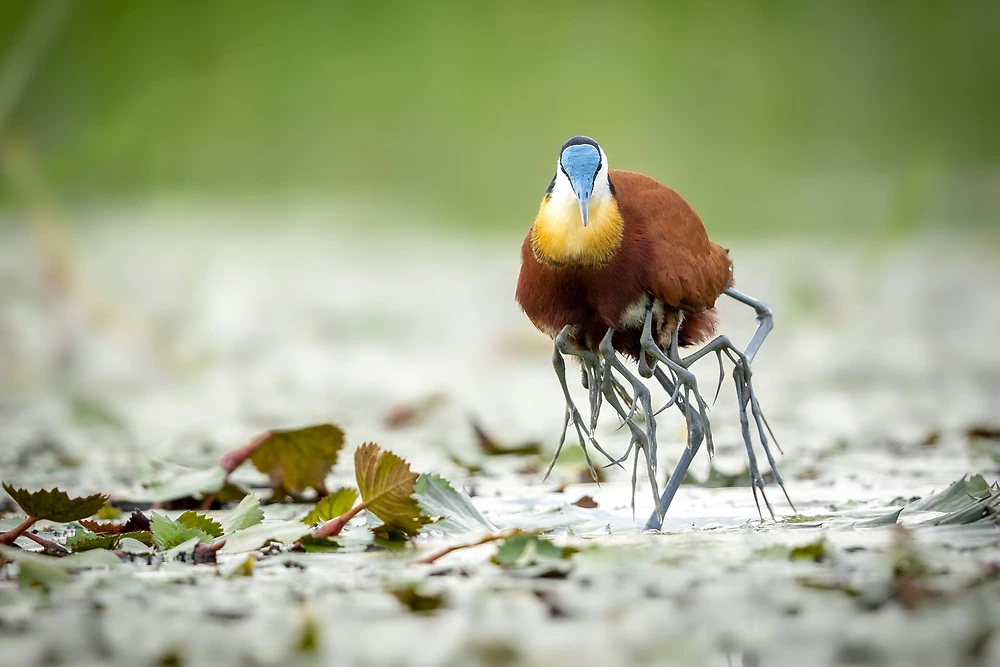
It's been a few years since I've discovered this beautifully weird animal; it must've been some Reddit post. I believe it was this exact image (or a very similar one), and of course it grabbed my attention immediately. What is going on here? What kind of eldritch creature am I looking at?
Some basic info (shamelessly cribbed from Wikipedia): The African Jacana is a bird from the supergroup of waders, who are commonly found along shorelines or in the vicinity of relatively shallow bodies of water. Its most distinguishing feature are its abnormally long toes, which it uses to walk across lilypads - making it look like its walking on water.
This, however, is not its only "weird" quirk. First off, the breeding strategy of African Jacanas is highly unusual in that they are polyandrous: One female mates with multiple males. Once the chicks hatch, she abandons them, and it's the males that do the childrearing. When the chicks are very young and inexperienced, walking over the lilypads is still difficult for them, especially in situations of high tension. In those situations, their fathers pick them up and carry them around, tucking them beneath their wings. Of course, because their feet and foes are so large, they end up sticking out. That is what the picture above shows - not some kind of horrible bird-spider hybrid with eight legs, but simply a Jacana dad taking his kids for a walk.
I find this bird fascinating because it's such a stark example of a very slim ecological niche, and the kind of adaptations it causes.2 Even though I knew that lilypads offer relatively strong support and that animals (like frogs) use them as floating platforms, I would've never thought that they could be the habitat that an entire species is "built around." But I guess if nature teaches you one thing, it's this: If an ecological feature exists, some kind of living thing is probably specialised for living in / on / with it.
To end this post, here are a few videos that show the African Jacana "in action."
- Walking on Water | African Jacana (nice and short, accompanied by some whimsical tunes)
- Jacana Dad Rescues his Chicks from a Crocodile (with very nice narration in the style of David Attenborough)
- Nature’s Lily Pad Walkers - The Jacana Bird Explained (with horrible narration, but also examples of other species of Jacana)
Footnotes
However, by outlining my thought process in this post, I still managed to sneak two animals into a text that should've only been about one.↩
By the way, the polyandrous breeding system is also caused by the Jacana's environment. I'm not going to type it out here, if you're interested you should check the Wikipedia article.↩