Hayao Miyazaki and optimistic nihilism
Yesterday, I found a post i think we're obsessed with aesthetic on the Discovery Feed. It featured quite a few nice quotes. My favourite was this one:
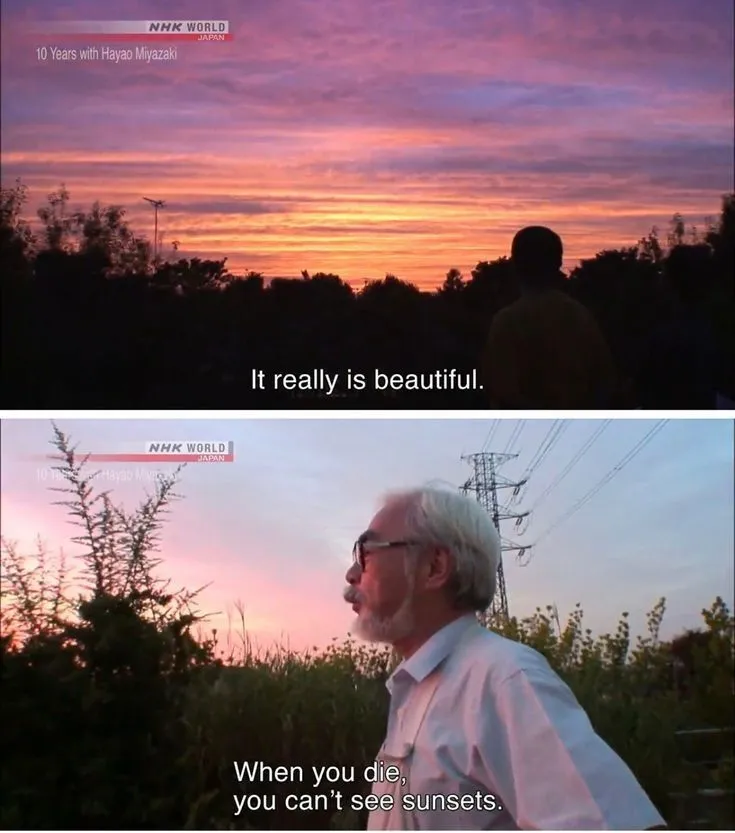
It's a real "people die when they are killed" kind of quote. Your first reaction is probably going to be some faint amusement, accompanied by a thought like Well, duh. Thanks, Captain Obvious.1 But aside from the factual layer, it also has a personal, contemplative element. This scene shows one of those moments where you see something that you've seen a thousand times and suddenly feel a deep sense of appreciation. You come from non-existence, and go back into it. The time where you get to experience sunsets or soothing spring rain or beautiful autumn leaves is just a tiny fraction of existence as a whole. From that perspective, even the most commonplace, mundane or tacky things can seem truly beautiful.
I think this scene is from the documentary "The Kingdom of Dreams and Madness", which has circulated pretty widely online. I've never actually seen the whole thing, just the clips of it that get uploaded on YouTube. Another one I like is this one. The interviewer asks: "Aren't you worried about the studio's future?"
Miyazaki's response:
The future is clear. It's going to fall apart. [laughs] I can already see it. What's the use worrying? It's inevitable. [...] "Ghibli" is just a random name that I got from an airplane. It's only a name.
He then walks away, and the interviewer quietly says "how beautiful", to herself. I find that last part ruins the scene a bit; it feels like the interviewer is telling the audience how to interpret what was just said. It would've been much more effective to just end with the shot of Miyazaki walking across the garden.2 However, a short scroll through the comments under the video will tell you that people still have different opinions on Miyazaki's stance. Some criticise him for being a stubborn old fart who'd rather let his studio fall apart than properly train a successor and make sure it continues to live on. Others just see him as a bitter nihilist.
To me, these quotes embody a kind of optimistic nihilism. Yes, nothing is forever. Everything will return to nothing one day; the world and our lives don't have inherent meaning. But despite of that, or rather precisely because of that, it becomes meaningful what you do with your life, and how you choose to live it.
Miyazaki's oeuvre makes it obvious that he's not a bitter defeatist who declared life to be meaningless and simply gave up. Quite the contrary, he's dedicated his life to art and creativity, with all the self-discipline, self-criticism, doubt and despair that comes with it. He's a "suffering artist" type, but not one that wallows in their suffering or sees it as the source of their art. He simply accepts it as a consequence of life.
When he laughs after saying that the studio is going to fall apart, it's not a laugh of self-pity, or a mask for disillusionment. It's a laugh born out of the awareness that all things will eventually fade away, and that, from a "cosmic" perspective, all human efforts are but small scratches on the ground. This serves as a way to balance out the deep attachment he has to his work. It's an Absurdist take, really. The same is true for the comment about the name of the studio. It's just that, a random name, an empty container, like a drinking glass. The glass is only a vehicle for the water, tea, or juice you fill it with. At the same time, it's what allows you to drink the water, tea, or juice - meaningless and meaningful at the same time.
Some of the comments under the YouTube video point out that the end of the movie The Boy and the Heron represents Miyazaki truly coming to terms with the things that he says in this interview, or maybe truly internalising their meaning. Instead of desperately trying to hold onto a form (the Studio) and trying to find a successor, he realises (and posits to us, via the movie) that it's not the form that matters, but the spirit. It doesn't matter whether or not people use your drinking glass - treating it as some kind of heirloom, or letting it shatter on the ground. As long as they too realise the value of drinking a cold lemonade on a summer evening or hot tea during a cold winter, any glass, cup or mug will do.
Unless you believe in some kind of afterlife where you get to enjoy sunsets for the rest of eternity.↩
This is a documentary, so it's obviously "staged" to some degree. I don't believe that Miyazaki is lying, or the interviewer is simply reading off a script with her response. Still, the context that allowed these images to get end up guiding them in a certain direction, another kind of inevitability.↩